 |
 |
|
PUKLLASUNCHIS
|
Prologue ׀ The Projects ׀ Biblio ׀ Credits
The rural community: A culturally and socially marginal society Between May and August of 1998 Pukllasunchis conducted an enquiry in all the rural and peri-urban communities of the Kachimayu River Valley (Erzinger; 2000). Using this wide sample it is possible to make certain statements about the socio-cultural background and the ecological and economic circumstances of these societies.
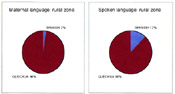
Fig. 4 and Fig. 5: The language that is used to communicate within the family in the rural
and in the peri-urban zone of the Kachimayu River Valley (Erzinger;
2000). It is apparent from this enquiry that nearly 100% of the families in the communities of the rural zone
- Huallarqocha, Tambomachay and Yuncaypata - are originally Quechua-speaking. But it has also been established that 10% of the originally Quechua-speaking families prefer to raise their children in the foreign language of Spanish. It would appear that this stems from a desire to facilitate access for the younger gene-ration to the modern, socially and economically privileged, Spanish-speaking society of Peru. But at the same time, these families are negating their social origin and relinquishing their cultural identity. This ongoing process is prevalent in the rural regions of the Andes, and the resulting loss of traditional knowledge in areas as medicine, mythology, ecology and history is incalculable, continual and irretrievable.
|
 |
|