 |
 |
|
PUKLLASUNCHIS
|
Prologue ׀ The Projects ׀ Biblio ׀ Credits
Natural resources: Possibilities and dangers The Kachimayu River Valley shows a wide diversity in its flora which adapted to the three ecological levels: the very humid sub-alpine, sub-tropical wasteland higher than 3'900 m.a.s.l., the humid, mountainous, sub-tropical forest between 3'900 and 3'500 m.a.s.l. and the dry moun-tainous low sub-tropical forest between 3'500 and 3'350 m.a.s.l. (IIUR; 1995). Pukllasunchis conducted an inicial investigation in colla-boration with the Institute of Ecology and Medical and Aromatical Plants (Instituto de EcologÌa y de Plantas Medicinales y Aromaticas IEPLAM) between January and June of 1998. About 190 different species have been iden-tified by their Latin, Quechua and Spanish names and regi-stered with photos. About 45 of these plants are known traditionally as medical remedies for all kinds of diseases and another 5 flowers are handed down as ornamental or mythical plants of the Inca era. Nowadays the local population is slowly losing its traditional knowledge of these plants as a result of the increasing influence of modern medicine in all the regions of Peru.
Fig.
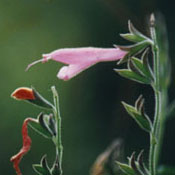
9: Salvia opositiflora (Quech.: Ñuqchu): A very rare pink mutation of the originally red species. In the Inca society it was used as ornament for the mummies. Extensive farming of mainly nutrition-extractive species like maize and potatoes makes another grave negative impact on the fertility of the soil. Most of this farming takes place in very steep terrain that is exposed to the erosion impact of the heavy summer rains. Many fields are harvested two times per year - first potatoes, later in the season maize - and some are even used for a third time to graze the herds during the dry winter season. The mixed cultivation of these crops together with native legu-minous plants (Leguminosae sp.) is known of but very rarely applied, probably as a consequence of lack of demand. This extreme over-use of the ground leads to a progressive erosion of the fertile soil which in turn results in an expansion of the terrain used for agricultural purposes. An additional problem for the nutrition equilibrium is the enormous loss of water caused by the loss of native woodland. Studies in the classification of eco-zones in this region have showed that according to the existing microclimates at least 45% of the whole area there should be covered by wood,
the appropriate percentage of terrain used for pure agriculture is estimated at about 5% and about 35% for pastureland (IIUR; 1995). In reality not more than 5% of the Kachimayu River Valley are covered by wood, mainly due to recent reforestation through introduced species such as Eucalyptus (Eucaliptus globulus). The loss of protection against the strong sun radiation and the raised water consumption of the Eucalyptus both contribute to the increasing decomposition and as a consequence to the progressive erosion of the fertile soil.
Fig. 11: Polylepis incana (Quech.: Q'euña): The only native tree that still exists in small woods on the banks of the River Kachimayu.
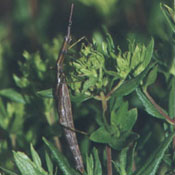
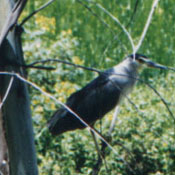
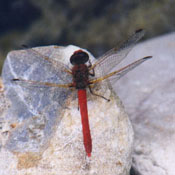
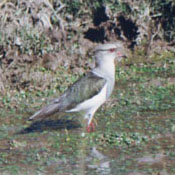
Fig. 13: Anchotatus peruvianus (Quech.: K'aspi kuru): The stick insect depends on uncultivated grassland. Another challenging ecological problem is the organic overload of the water (eutrofication) by human and animal excrement and detergents. Both the river and the open water pipes are often so highly polluted that already in the first community of the current the drinking water can not be consumed uncooked. This situation results in high external costs for all the communities in the valley and also has a strong negative impact on the aquatic ecosystems and, in consequence, on the survival of certain aquatic insects and amphibians. These animals depend directly on the purity and quality of the water. The organic overload can provoke an explosive reproduction of certain organotrophic aquatic microorganisms, while the toxic detergents reduce the survival possibilities of the more sensitive aquatic animals. On an indirect level, the state of aquatic systems also affects the numbers of many birds and reptiles that hunt these aquatic insects and amphibians.
|
 |
|