 |
 |
|
PUKLLASUNCHIS
|
Prologue ׀ The Projects ׀ Biblio ׀ Credits
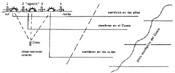
The historical relics: The integrating society of the Incas Alongside architecture and governmental and military organisation, one of the mayor achievements of the Inca society was the solar calendar that was introduced by the Inca Cusi Yupanqui Pachacútec (1438 - 1471). Pachacútec means in Quechua "the person with whom began a new era". He was the emperor who initiated the expansive military campaign of the Incas to extend their kingdom towards a pan-Andean empire (Espinoza; 1997). Since the pre-Hispanic Andean societies knew no monetary system they cultivated an inter-regional, centrally administered system of redistribution within which maize was accorded a particularly high value. Considering the interconnectedness of political and religious power with the agricul-tural production of these highly valued crops, an inter-regional time system such as the solar chronology is of vital importance. The sun was the only universally observable time indicator within the various eco-levels that make up the complex macro-ecosystem of the Andes. It is supposed that a sequence of grave eco-collapses, followed by the bloody elimina-tion of the Inca ruling elite, led to the implementation of the new chrono-logy. This reorganisation of the state set the violent events in motion that were to lead to the eventual expansion of the Inca Empire from northern Chile to southern Columbia. From this socio-scientific revolution onwards, time was measured throughout the whole Inca Empire by a system of four columns constructed in specific positions according to the area in such a way that the rising sun entered the three interspaces synchronically as the season progressed. Each of the three time intervals corresponded to the sowing period of one of the three main eco-levels of the Cusco region (Earls; 1976).
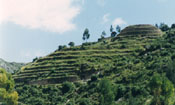
Besides their knowledge of astronomy and its application to the local agriculture, the Incas also had an advanced understanding of complex physical and ecological processes. It is supposed that they knew about the physical effects of terracing in a steep landscape. It has been proven that this system not only retains humidity and prevents the erosion of fertile soil, but also that it improves significantly the local microclimate. As a result the difference in altitude between natural eco-levels is reduced by a factor of 71. In other words, certain agricultural species that may naturally be separated by 70 metres of altitude can be cultivated within one single metre. This facilitated an optimal distribution of agricultural activities and the breeding of a maximum number of genetic species (Earls; 1976).
|
 |
|